
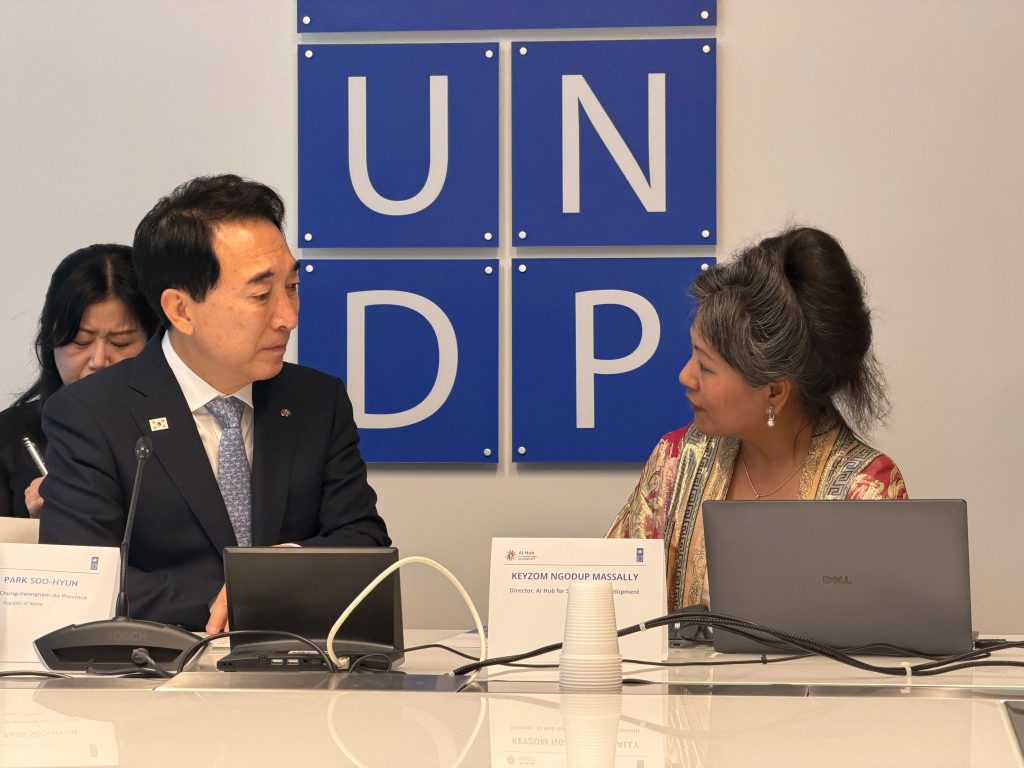
Rome, August 27, 2026 — Today, Governor Park Soo-hyun of Chungcheongnam-do Province, Republic of Korea, visited theAI Hub for Sustainable Development in Rome, as part of a broader mission to Italy. The visit follows a formal request from the province—known as the AI capital of Korea—to learn more about the AI Hub’s model for public-private partnerships in applying AI to sustainable development.
It comes at a time of renewed momentum in Italy-Korea relations. In June 2026, President Lee Jae-myung and Prime Minister Giorgia Meloni elevated bilateral ties to a special strategic partnership and adopted a 2026–2030 strategic action plan that focuses on artificial intelligence and high-tech cooperation.
The AI Hub for Sustainable Development is a G7-approved initiative co-led by the Ministry of Enterprise and Made in Italy (MIMIT) and the United Nations Development Program (UNDP), launched in 2025 following Italy’s G7 presidency. It brings together committed G7 members and African industrial partners around concrete applications of artificial intelligence, ranging from agriculture to education, language and speech technology, and data centers. Two features distinguish the AI Hub’s partnership model: it brings together founders, industry, and public institutions to build collaboratively; and it provides dedicated programmatic funding to co-invest with partners in Africa, ensuring that collaboration moves from dialogue to implementation.
The AI Hub’s partnership model builds on the broader work advanced during Italy’s G7 presidency in 2024. This included “Growing Together: Building Public-Private Partnerships to Accelerate the AI Revolution,” a G7 conference convened at INNOVIT in San Francisco in November 2024 under the leadership of the Italian Ministry of Foreign Affairs and International Cooperation (MAECI). The question then, as now, was who actually puts AI in people’s hands and builds the capacity, infrastructure, and markets surrounding it. Not just governments, not just the UNDP, and not just traditional aid. The private sector had to be at the center: African developers who understand the problem and global partners with the tools and market reach to solve it on a large scale.
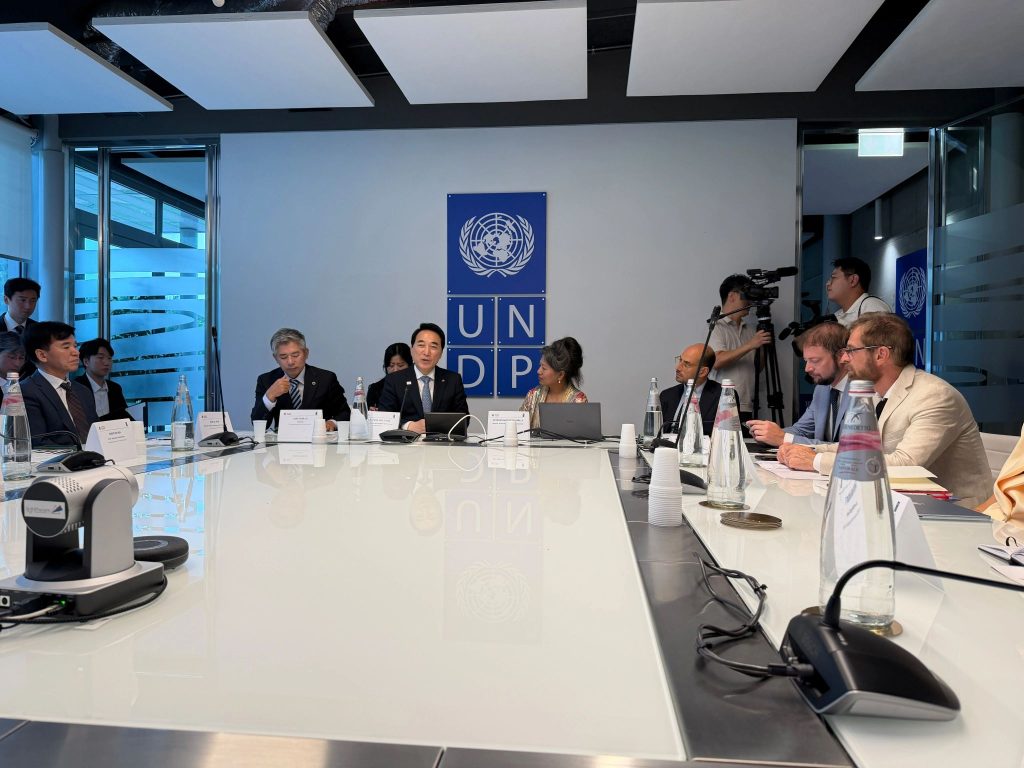
The Governor was received by Federico Eichberg, Chief of Staff at the Ministry of Enterprise and Made in Italy (MIMIT); Sergio Strozzi, Counselor at the Embassy and Head of Office IV—Promotion of Innovative Industrial Supply Chains and Startups; Directorate General for Growth and Export Promotion (DGCE), at the Ministry of Foreign Affairs and International Cooperation, and by Counselor Fabio Massimo Ballerini, Advisor on the Mattei Plan for Africa at the Presidency of the Council of Ministers; along with Keyzom Ngodup Massally, Director of the AI Hub for Sustainable Development and Global Head of Digital and AI Programs at the UNDP, Duccio Tenti, Head of Strategy and Partnerships at UNDP in Italy, and Maria Giulia Vitagliano, Head of Strategic Engagement at the AI Hub for Sustainable Development at UNDP.
Participants also included representatives from the European Commission Delegation to Italy, the FAO Office for Innovation, Terna, Cyber 4.0, Harmonic Innovation Group / Entopan, and LUISS University.
“The special strategic partnership between Italy and the Republic of Korea places artificial intelligence at its core, and exchanges like this—at the practical level rather than just in words—are how that cooperation takes shape,” said Federico Eichberg. “What we hope to promote with Governor Park and his delegation is not the presentation of a single model, but an open exchange on approaches that have yielded results, lessons learned, and the conditions that enable public-private cooperation to work in practice.” The Italian government highlighted its “Italia-Africa Mattei” plan, emphasizing small and medium-sized enterprises, youth-led artificial intelligence innovations, and international cooperation as areas of shared global leadership with South Korea.
The AI Hub’s industry partners presented their collaborations with their African counterparts. Francesco Cicione, founder of Harmonic Innovation Group, outlined a human-centered approach to AI in which ethical and value-based considerations are incorporated directly into the reasoning process rather than applied afterward as external safeguards. Drawing connections between Mediterranean humanism and Korean and broader East Asian traditions, he emphasized that questions regarding the human implications of AI transcend individual regions and cultures.
DeepLeaf, a Moroccan startup that applies AI to crop health and food safety, and Cyber 4.0, through its program Cyber4Africa, explained The AI Hub’s work on AI adoption pathways: reusable pathways that demonstrate how a proven AI application achieves widespread adoption, so that every new adopter can build on what already works rather than starting from scratch. DeepLeaf has opened up its core model so that local founders across the continent can build tools tailored to their own crops and countries, transforming a single product into a shared infrastructure that now reaches millions of farmers with timely and reliable crop advice.
Cyber 4.0 strengthens the level of trust that makes this adoption sustainable, empowering African startups to build robust cybersecurity into their systems from the very beginning, so that AI can scale without eroding the trust of the communities it serves.
Terna highlighted its collaboration with NextAV, a Tunisian innovator participating in the AI Hub’s Compute Accelerator under the Compute Ready Track and in the Global Scaleup Program of the Terna Innovation Zone Tunisia. NextAV applies AI-based super-resolution to public satellite imagery for monitoring energy, climate, and infrastructure. Building on this work, Terna is conducting a proof of concept with NextAV to test AI-driven enhancement of satellite imagery for infrastructure design and monitoring, based on a Terna use case.
“Better models don’t automatically produce better results. Someone still has to make AI work in the real world,” said Keyzom Ngodup Massally, Director of the AI Hub for Sustainable Development at UNDP. “On the other hand, when industry innovates and builds in partnership with governments and communities, the solutions that emerge work for more people, in more contexts. AI can be the great equalizer, if we choose to scale it up.”
Governor Park Soo-hyun highlighted Chungcheongnam-do’s distinctive approach to AI transformation, noting that while AI transformation has been included in the recent campaign pledges of Korea’s metropolitan and provincial governments, most have focused primarily on industrial development. “Chungcheongnam-do, however, has taken a different approach. We believe that if we do not pay close attention to the impact of AI on people, the gap between industry and people will widen in the digital age. That is why Chungcheongnam-do has placed the balance between people and AI at the center of its AI policy commitments,” he said. He also emphasized that Chungcheongnam-do is one of the Korean local governments whose vision and direction are aligned with those of the UNDP AI Hub for Sustainable Development.
Governor Park also expressed strong interest in building a close partnership with the AI Hub for Sustainable Development, saying that Chungcheongnam-do hopes to continue discussions to establish a formal partnership, including the possibility of a memorandum of understanding (MOU) and to develop concrete areas of cooperation in the future.
The AI Hub for Sustainable Development welcomes visits from governments and institutions seeking to understand its model, as one of many examples of how public and private sector actors can collaborate on AI.
Source: Press Release / Official Statement from the Ministry of Enterprise and Made in Italy (MIMIT).